
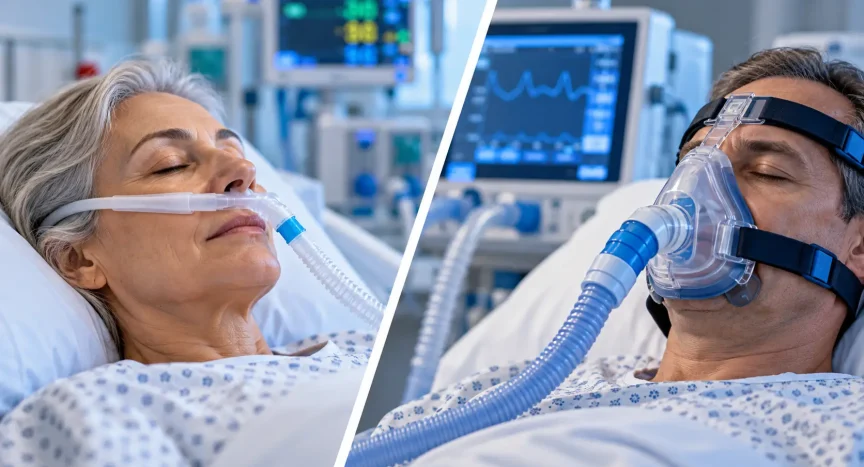
A Clinical Review of Physiological Mechanisms, Indications, and Strategy Selection
The clinical management of acute respiratory failure (ARF) has undergone a profound evolution. Traditional reliance on rapid endotracheal intubation and invasive mechanical ventilation has shifted toward advanced non-invasive oxygenation and ventilation techniques. Among these, High-Flow Nasal Cannula (HFNC) and Non-Invasive Ventilation (NIV) stand as the twin pillars of contemporary respiratory support.
While both modalities aim to avoid the complications of invasive ventilation—such as ventilator-associated pneumonia and airway trauma—they operate via fundamentally different physiological mechanisms. Deciding between HFNC and NIV requires a deep understanding of patient comfort, gas exchange dynamics, and underlying disease etiology.
Physiological Mechanisms
A clear mechanical divergence separates HFNC and NIV, mapping distinct therapeutic interventions onto specific physiological requirements.
High-Flow Nasal Cannula (HFNC)
HFNC utilizes a specialized, open-circuit nasal interface to deliver heated (37°C) and fully humidified air-oxygen blends at high flow rates ranging from 30 to 60 L/min. Its therapeutic efficacy depends on three key features:
- Anatomical Dead-Space Washout: By continuously flushing the upper airway, HFNC clears expired carbon dioxide (CO2), creating a functional reservoir of pure oxygen that enhances ventilatory efficiency.
- Flow-Dependent Positive Airway Pressure: HFNC generates a modest, dynamic positive end-expiratory pressure (PEEP)—approximately 1 cm H2O for every 10 L/min of flow under closed-mouth conditions—which provides mild alveolar recruitment.
- Inspiratory Flow Matching: The high flow rates meet or exceed the patient’s peak inspiratory demand, reducing entrainment of ambient air and ensuring strict adherence to the set fraction of inspired oxygen (FiO2).
Non-Invasive Ventilation (NIV)
NIV encompasses Continuous Positive Airway Pressure (CPAP) and Bilevel Positive Airway Pressure (BiPAP), delivered via a tight facial, nasal, or helmet mask interface. Unlike the open circuit of HFNC, NIV relies on a hermetic seal to generate fixed, pressure-targeted breaths:
- Active Work of Breathing (WOB) Reduction: By delivering an Inspiratory Positive Airway Pressure (IPAP) that exceeds the Expiratory Positive Airway Pressure (EPAP), BiPAP unloads the respiratory muscles, actively augmenting the patient’s tidal volume.
- Robust Alveolar Recruitment: A sustained, high EPAP elevates mean airway pressure, re-opening collapsed alveoli and shifting fluid out of the alveolar spaces in conditions like pulmonary edema.
Comparative Feature Analysis
| High-Flow Nasal Cannula (HFNC) | Non-Invasive Ventilation (NIV) | |
| Circuit Type | Open nasal cannula | Sealed interface (mask/helmet) |
| Primary Mechanism | Dead-space washout, precise FiO2 | Pressure-driven ventilation and recruitment |
| Max Pressure Support | Minor/variable (~2–6 cm H2O) | High/fixed (IPAP up to 20+ cm H2O) |
| Patient Tolerability | Excellent; allows speaking and eating | Lower; risk of claustrophobia and skin lesions |
| CO2 Clearance Efficacy | Mild to moderate | Profound and rapid |
| Risk of P-SILI | Lower due to spontaneous regular volumes | Higher if high driving pressures generate excessive volume |
Clinical Indications: When to Choose Which Modality
1. Acute Hypoxemic Respiratory Failure (“De Novo”)
For patients experiencing pure hypoxemic respiratory failure without hypercapnia (e.g., severe pneumonia), clinical trials point toward an initial trial of HFNC.
The landmark FLORALI trial demonstrated that while intubation rates did not differ significantly overall between standard oxygen, NIV, and HFNC, a crucial sub-analysis of severely hypoxemic patients (PaO2/FiO2 ≤ 200 mmHg) favored HFNC for preventing intubation. Furthermore, HFNC demonstrated a clear 90-day survival benefit.
Recent meta-analyses confirm that HFNC achieves equivalent or superior intubation reduction compared to NIV while cutting the average length of hospital stay by approximately 1 day due to enhanced patient compliance. A primary risk of NIV in this population is Patient Self-Induced Lung Injury (P-SILI), where excessive transpulmonary pressure swings generate dangerously high tidal volumes.
2. Acute Hypercapnic Respiratory Failure (e.g., COPD Exacerbation)
For acute exacerbations of chronic obstructive pulmonary disease (AECOPD) presenting with respiratory acidosis (pH < 7.35), NIV remains the undisputed first-line standard of care.
NIV directly addresses the underlying pathology by assisting fatiguing respiratory muscles, increasing alveolar ventilation, and clearing carbon dioxide far more rapidly than HFNC.
However, meta-analyses highlight a role for HFNC as a rescue therapy or “bridge therapy” for patients who experience treatment failure with NIV due to severe facial skin breakdown, gastric distention, or claustrophobia. HFNC can maintain a stable physiological state during NIV rest periods, preventing immediate rebound acidosis.
3. Acute Cardiogenic Pulmonary Edema (ACPE)
In cases of acute heart failure presenting with pulmonary edema, NIV (specifically CPAP or BiPAP) is strongly indicated.
The intrathoracic positive pressure generated by a sealed NIV mask reduces right ventricular preload and left ventricular afterload, providing a distinct hemodynamic benefit that accelerates clinical stabilization.
Head-to-head meta-analyses indicate that while HFNC improves oxygenation and lowers respiratory rate, its lack of sustained high airway pressure makes it clinically inferior to NIV in rapidly reversing cardiogenic fluid shifts, though it remains a viable alternative if mask compliance is completely impossible.
4. The Immunocompromised Patient
In immunocompromised cohorts (e.g., hematological malignancies, post-transplant), HFNC is strongly preferred over NIV.
These patients carry an exceptionally high mortality rate if invasive mechanical ventilation becomes necessary. HFNC offers a reliable, low-risk technique to maintain oxygenation while minimizing the nosocomial and device-related skin/airway infection risks associated with tight-fitting mechanical ventilation seals.
Navigating Treatment Failure
Regardless of the initial non-invasive modality chosen, strict monitoring for treatment failure is essential. A common error in managing acute respiratory failure is delaying intubation when non-invasive support fails, which significantly increases mortality.
ROX Index = (SpO2 / FiO2) / Respiratory Rate (breaths/min)
A ROX index < 4.88 assessed at 2, 6, and 12 hours signifies a high risk of treatment failure, serving as an early warning to transition to NIV or proceed directly to invasive endotracheal intubation.
For patients on NIV, baseline predictors such as a pH < 7.25, PaCO2 > 70 mmHg, or a persistent respiratory rate > 32 breaths/min after 1–2 hours of support signal an immediate need for invasive airway management.
Conclusion and Future Horizons
Rather than competing alternatives, HFNC and NIV form a dynamic, integrated continuum of non-invasive respiratory support. The choice between them should never be reductive; it must be rooted firmly in the patient’s individual pathophysiology. HFNC provides an elegant, highly tolerable platform optimized for pure hypoxemic failure, anatomical dead-space clearance, and prolonged programmatic wear. Conversely, NIV serves as an active respiratory pump, indispensable for profound mechanical ventilatory failure, respiratory muscle fatigue, and acute cardiogenic decompensation.
The future of non-invasive respiratory care lies in predictive, personalized management. Incorporating real-time tools like point-of-care diaphragm ultrasound alongside adaptive, closed-loop machine learning algorithms will allow automated adjustment of flow rates and driving pressures. By treating HFNC and NIV as complementary modalities and meticulously observing established failure indexes like the ROX score, clinicians can effectively maximize therapeutic efficacy, avoid the multi-system risks of invasive ventilation, and substantially improve patient outcomes.
References
- Frat, J. P., et al. (2015). High-flow nasal oxygen versus noninvasive ventilation for acute hypoxemic respiratory failure. New England Journal of Medicine, 372(23), 2185-2196.
- Rochwerg, B., et al. (2020). European Respiratory Society clinical practice guidelines: noninvasive ventilation for acute respiratory failure. European Respiratory Journal, 56(2).
- Oczkowski, S., et al. (2022). Noninvasive respiratory support for adults with acute respiratory failure: a clinical practice guideline from the American Thoracic Society. American Journal of Respiratory and Critical Care Medicine, 206(8), 916-930.
- Wang, Y., et al. (2023). Comparison of High Flow Nasal Therapy with Non-Invasive Ventilation and Conventional Oxygen Therapy for Acute Hypercapnic Respiratory Failure: A Meta-Analysis of Randomized Controlled Trials. Journal of Clinical Medicine, 12(11), 3740.
- Chest Journal Systematic Review. (2025). High-flow nasal cannula versus non-invasive ventilation in acute hypoxemic respiratory failure: A meta-analysis of randomized controlled trials. Chest, 168(4), A1947.
- Frontiers in Medicine Meta-Analysis. (2026). High-flow nasal cannula versus non-invasive ventilation in acute heart failure related respiratory failure. Frontiers in Medicine, 13, 194116.


Customer Reviews
Thanks for submitting your comment!